
What it is, in one paragraph
Guitar players who use modern digital rigs have a problem nobody talks about. The gear can do almost anything, and getting it to do one specific thing means hunting through hundreds of menus on a screen the size of a postcard. You know the sound you want. You just cannot find the twelve settings that make it.
ToneCommand lets you ask for it in plain English instead. You type something like "tighten up the low end and give me a bit more bite for drop C", and it works out exactly which settings that means on your rig, shows you the list, and changes them only when you say go.
It is free, it runs on your own computer, and anyone can read every line of how it works.
Watch it build a rig from nothing
One typed sentence: a Judas Priest preset, all eight scenes, different albums and eras. The recording starts on a freshly erased, completely empty preset slot. Six minutes later the finished rig is standing on the hardware, every scene named on the footswitches, saved under its own name.
Unedited, on a real FM9, on version 0.8.0. The AI in this run was a GPT model; bring whichever you like.
Who it is for
Right now, people who own a Fractal FM9. That is a guitar processor a lot of touring and worship players use: it replaces a wall of amplifiers and pedals with one unit. Powerful, and famously deep to program.
If you do not own one, this page is a look at what Moncy builds when he is not writing songs. If you do own one, the next section is the useful part.
What it actually does
- You describe, it translates. "Give me a Steve Lukather lead sound in scene 4." It knows what amplifiers, speaker cabinets and effects your unit has, picks the right ones, and sets them.
- It shows its work before it touches anything. Every single change is listed for you first. Nothing reaches your gear until you press the button that sends it.
- It never leaves you wondering. A big build takes the AI a few minutes, and you watch the whole thing: a live counter as each change is written, then each one ticked off as it lands on your rig, then a plain green "done, play it". If one change out of a hundred fails, it names which one and why. And there is a STOP button that genuinely stops the machine, on your computer and behind the scenes, instead of just hiding the wait.
- It can start from nothing. Point it at an empty preset slot and it wires the signal chain itself, input to amplifier to cabinet to output, then builds the tone you asked for on top. One sentence in, a finished preset out, with every scene named after what it is for and saved under its own name.
- It warns you before you break something. On this hardware, changing one sound can quietly change several others that share the same settings. That is how people wreck a preset that was working fine. ToneCommand lights up every sound that would be affected, in amber, before you commit.
- Undo, which the unit itself does not have. It quietly photographs everything before each change, so you can always go back. You can also flip between two versions to compare them.
- It checks your presets for you. It walks through every sound in a preset and tells you whether audio can physically get through. It found three sounds in one of Moncy's own presets that were secretly identical, under three different names. One was called PITCH and had no pitch effect in it at all. That preset had been played live.
- Finding sounds fast. There are 331 amplifiers and over 2,200 speaker cabinets in the unit. On the hardware you thumb a knob through them one at a time. Here you type two letters and arrow through the shortlist while you keep playing.
- It works with the rig switched off. Build tones on a plane or a sofa. They are kept, and go out to the gear when you plug back in. And it watches the cable: unplug the unit and the link light goes red within a second, plug it back in and it reconnects by itself, no clicks, no restart.
- Gig mode. One switch in the header locks the rig down for the stage. While it is on, nothing reaches your gear except scene changes, and everything else is refused with a plain reason. Made for playing live, whether that is a Sunday worship set or a metal show.
- Players can share tones. Not preset files, which would mean handing round other people's paid content. Instructions, which get rebuilt on your own rig with your own gear.
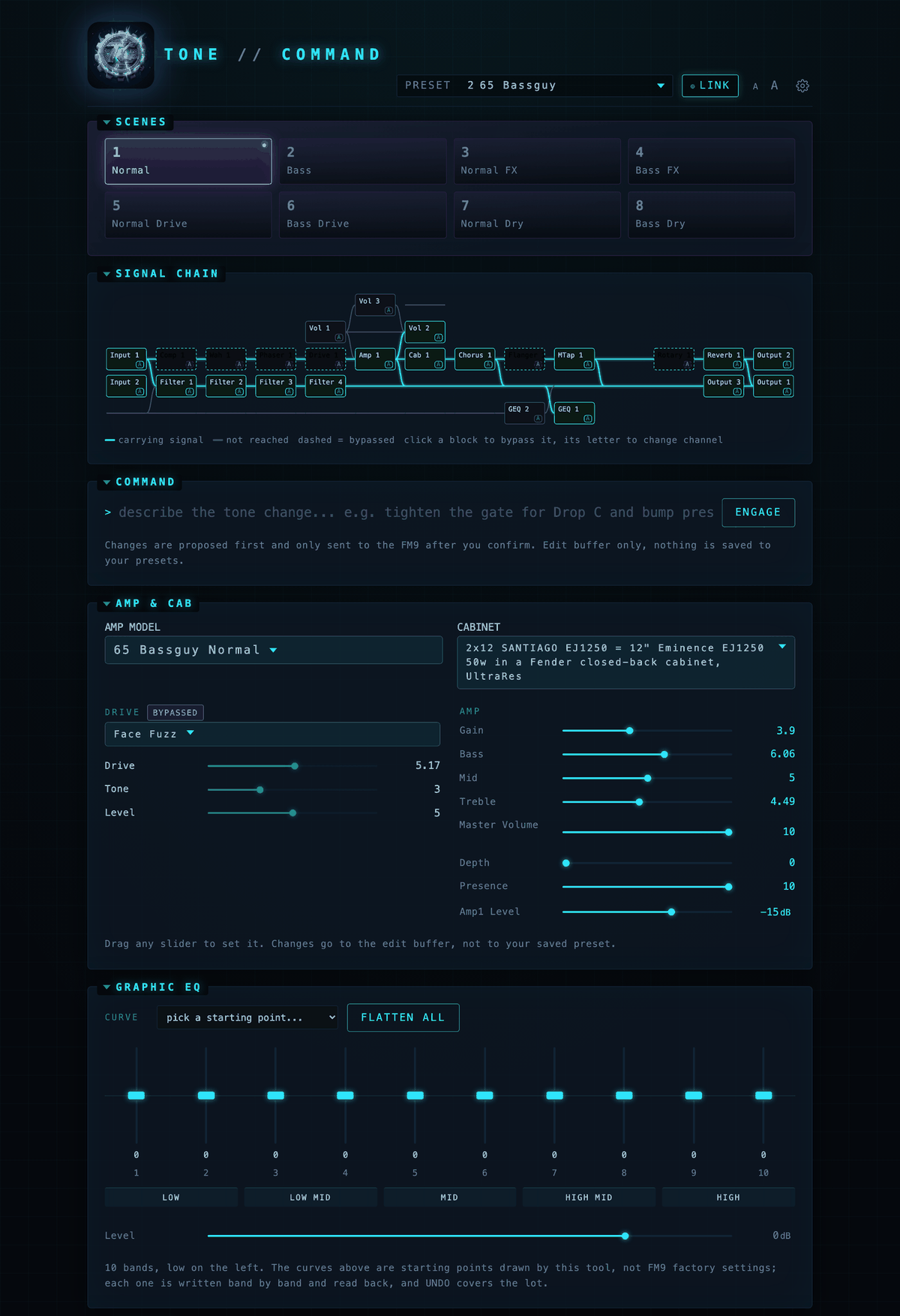
Everything here is live from a real FM9. Nothing on this screen is a mock-up.
Why "humans in command"
This is the part that matters, and it is the same conviction as everything else on this site.
ToneCommand uses AI to work out what you meant. It never uses AI to decide what happens to your equipment. The machine proposes. You dispose. There is no automatic mode, no button that says "just do it", and no path from a sentence you typed to your hardware that does not go through you reading the list first.
It also refuses to pretend. If it cannot verify something, it says so instead of inventing a confident answer. If it cannot know whether a change actually worked, it tells you to go and listen rather than claiming success. Every check it runs finishes with the same line:
Ears: pending, always.
A computer can prove the signal is getting through and the settings landed. It cannot tell you the tone is good. That was never its call to make.
About the emblem
The letters are TC, and they sit inside a gear.
The gear is deliberate. Not a musical note, not a sound wave, not another picture of an amplifier knob. A machine part, because that is what this is: something built, in a workshop, by hand.
The materials in it tell the story. Burnished bronze for the old soul, the warmth of tubes and transformers and the gear guitar tone has always been made of. Heat-blued steel for the workmanship. And the electric blue fire running through the circuit traces is the new machine, the intelligence, the part that is genuinely new.
Old and new, wrapped around each other, with a human monogram at the centre holding both. That is the whole idea in one image, and it is why the tagline reads the way it does.
Wear it
The emblem is on two shirts in the Shieldbearer shop, both printed on demand and shipped worldwide.
- ToneCommand Emblem Tee, $29.99. Black heather, 100% combed ring-spun cotton, pre-shrunk, side-seamed. Sizes XS through 5XL. Big front chest print.
- ToneCommand Performance Jersey, $29.99. Black, 100% breathable polyester mesh, moisture-wicking, relaxed fit with an extended length and short raglan sleeves. Sizes S through 2XL. Made to actually play in, on a hot stage.
Both carry the line at the top of this page.
Get the software
Free, and free forever. It is open source, which means the code is public, anyone can read it, and anyone can suggest improvements. Several people already have, and their names are on it.
It runs on your own machine and works with whatever AI you already use, including ones that run on your laptop with no account and no internet at all.
Built on a real rig, for real shows. Worship sets on Sunday, and metal when the stage calls for it.